

Our client provides field service management software on a platform where every customer has its own database. We turned about 1,000 of those databases into one analytics layer, and put reporting and AI analysis inside the product itself.
At a glance
- Before
- About 1,000 single-tenant customer databases that had drifted apart over the years
- What we built
- One analytics layer, consolidated, harmonised and modelled once for every customer
- Inside the product
- Embedded reporting and AI narratives, with no exports or separate tools
- A second use
- The same per-customer data also feeds the client's internal customer intelligence platform
The challenge
Our client provides cloud software to businesses that run field operations at scale. Its customers wanted to see how their own operations were performing, and the business wanted to offer that as part of the product rather than leaving customers to export data and build reports elsewhere.
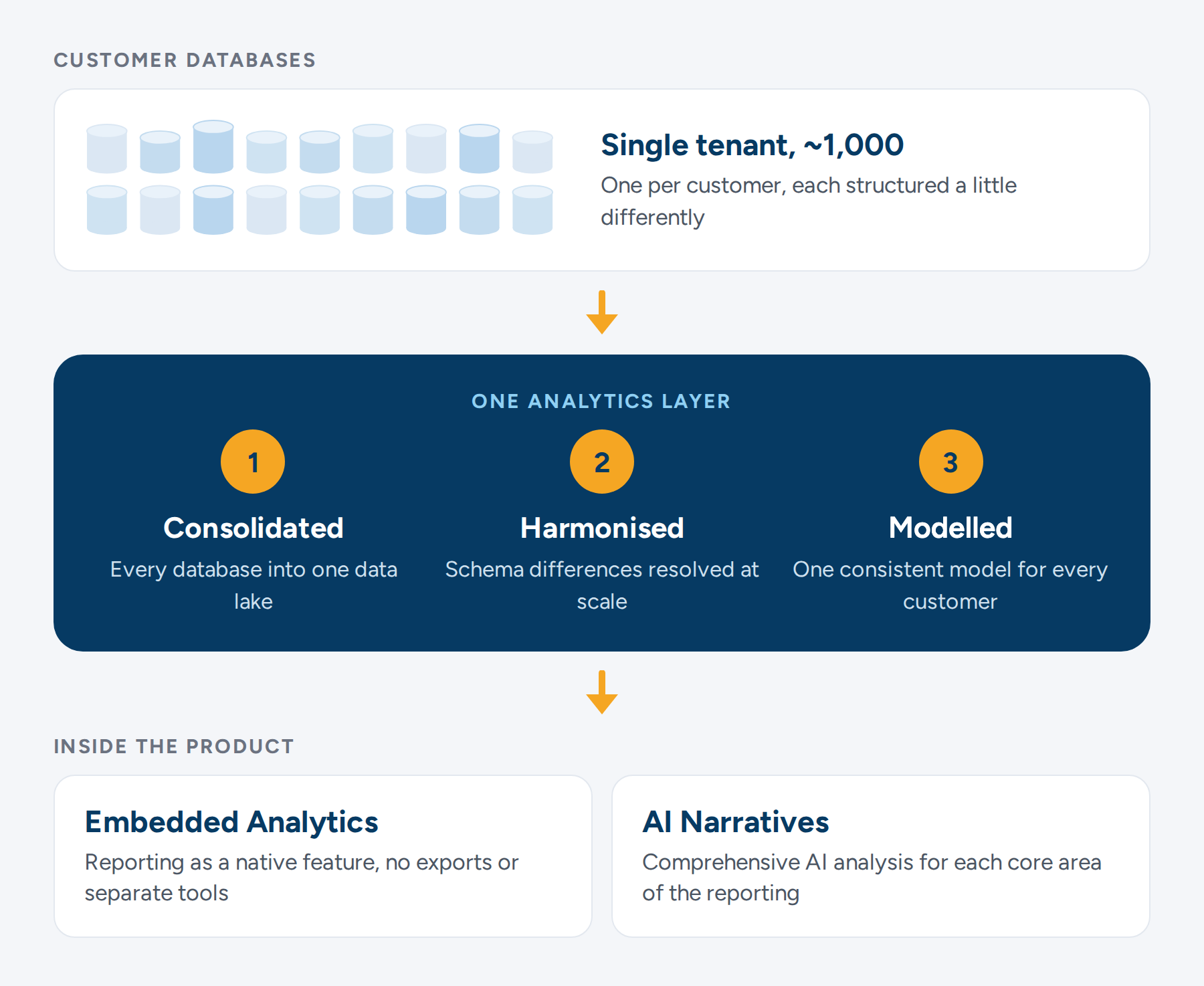
The architecture made that hard. The platform is single tenant, so every customer has its own database, and there are around 1,000 of them. Over years of growth and product changes, those databases had drifted apart: tables and fields that should have matched were named, structured or populated differently from one customer to the next.
Reporting across one customer was straightforward. Reporting that worked the same way for every customer, from a single build, was not possible while each database told the story in its own shape.
Our approach
We built one analytics layer underneath the product in three stages on Databricks, then put reporting and AI analysis on top of it using Power BI Embedded.
Consolidated. We brought every customer database into a single Databricks data lake designed for product analytics, so reporting could be built once and served to every customer, rather than built and maintained a thousand times over.
Harmonised. The core technical problem was schema variation. We resolved the differences between databases at scale, so the same table and the same field mean the same thing for every customer.
Modelled. On top of the harmonised data, we built one consistent analytics model. Every report, metric and narrative draws on the same definitions, whichever customer is looking.
On top of that layer, customers get two things.
Embedded analytics. We delivered the reporting with Power BI Embedded, directly inside the client's platform. Customers open it in the software they already use every day, with no separate tool, no export and no waiting for someone to build a report.
AI narratives. Alongside the reports, each core area of the analytics carries a comprehensive AI analysis of what the numbers show for that customer. A customer can see what has changed and why it matters without having to interpret every chart, and because the analysis is grounded in the same model as the reports, the two always agree.
The impact
The client gained a feature set that did not exist before. Every customer now has analytics and AI analysis as a native part of the product, built once from a single model rather than customer by customer.
The consistent model also changed what the business can do next. New reports and new AI analysis can be added for every customer at the same time, and the per-customer operational data now has a second use inside the business: summaries of each customer's own activity, such as the work orders they create each month and the value behind them, also feed the client's internal customer intelligence platform.
We also built an AI layer for the same client's customer-facing teams: read that case study.