
The challenge
Every customer-facing team at our client needed the same thing: a complete view of each customer. Customer Success, Support, Sales, Services and Product were all looking at the same accounts, and no two of them were looking at the same picture.
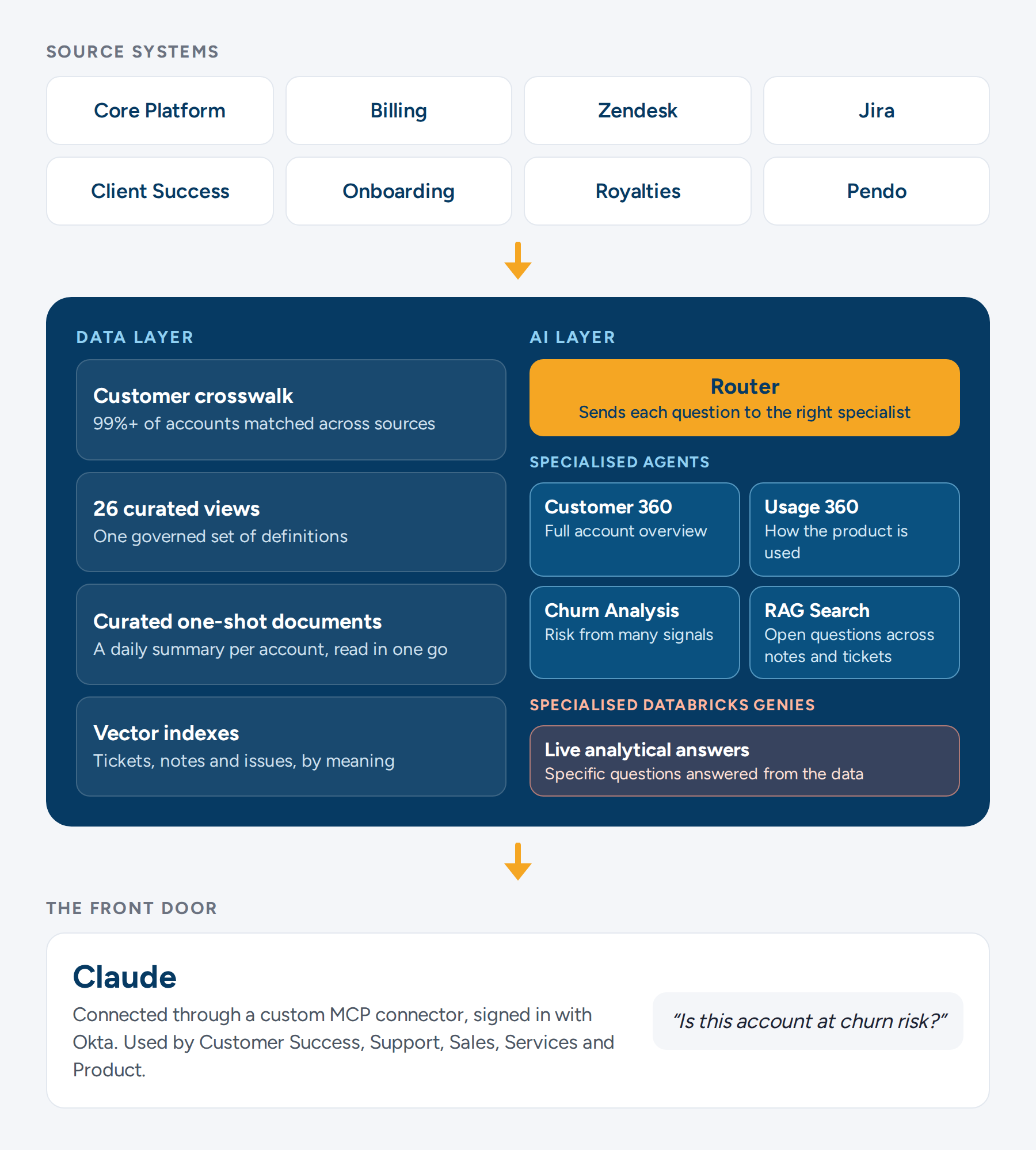
The data existed, spread across eight systems: the core platform (accounts, users and subscriptions), Zendesk, Jira, the Client Success system, billing, onboarding, royalties and Pendo for product usage. What was missing was anything that joined it up. There was no master customer record that every system could be reconciled against, so even a simple question about one account meant opening several tools and piecing the answer together by hand.
And the questions that mattered most were not simple. "Is this account at churn risk?" depends on support trends, product usage, billing changes and what the CS team has noted, all at once. Nobody could get a properly synthesised answer to that in seconds.
Our approach
We ran the build as two parallel workstreams, one for the data and one for the AI, with the data always one step ahead. The data foundations and the AI capabilities are different disciplines, and AI built on data that is not ready looks impressive in a demo and falls apart in use.
Resolving identity first. Every system identified customers in its own way. We built an automated customer crosswalk that combines direct ID matching, fuzzy matching and AI-assisted matching to resolve every source to one authoritative account, and it now matches more than 99% of active accounts. If the AI cannot say which tickets belong to which customer, nothing built on top of it can be trusted.
A governed data layer. On Databricks, we built 26 curated views across the source systems: one set of definitions that dashboards, agents and analysts all draw on. Curated one-shot documents give every active account a daily Customer 360 summary, covering support history, CS notes, billing, onboarding, usage and account flags, which the AI can read in a single step. Vector indexes make tickets, notes and issues searchable by meaning, not just keywords.
A router and a roster of specialists. Instead of one agent trying to answer everything, a small router reads each question and sends it to the right specialist. Some are specialised agents, and others are topic-focused Databricks Genies:
- Customer 360 gives a full account overview in seconds, drawing on the daily summary to tell one story across support, CS notes, billing, onboarding and account health.
- Usage 360 shows how each customer uses the product and what they achieve with it, combining product usage with summaries of the customer's own operational activity.
- Churn Analysis weighs support, usage, billing and CS signals to produce a consistent churn risk assessment.
- RAG Search handles open-ended questions, finding anything relevant across notes, tickets and issues.
- Databricks Genies are specialists in their own right, each focused on one topic. They let anyone ask the data anything across that topic, in plain English, and get a live answer straight from the data.
Broad questions are answered from pre-built summaries, so they are fast; specific questions are answered live, so they are current. Each specialist can be improved on its own, and new capabilities are added as new specialists rather than rewrites.
Claude as the front door. Rather than build and maintain a custom chat app, we exposed the platform to Claude, which the client already uses, through a custom MCP connector. Sign-in runs through the client's existing Okta setup, so joiners and leavers are handled automatically. The effort that would have gone into a chat interface went into the quality of the answers instead.
The impact
Any team can now ask about any account in plain English and get an answer drawn from across all eight systems in seconds: a full account summary, a view of how the customer uses the product, an answer to almost any question about the data, or a churn risk assessment with the reasons behind it.
For the first time, the business has one trusted view of every customer relationship, and every team sees the same one. Questions that used to need several tools and someone's afternoon are answered in a conversation.
The platform is built to grow. Upsell and downsell signals, broader natural language querying and proactive alerts when account health changes are next, followed by support triage and automated CS notes. None of them need the foundations rebuilt: each is a new specialist behind the same router.
For the architecture in more depth, read our insight on building an AI layer across an enterprise. We also built the embedded analytics inside the same client's product: read that case study.