
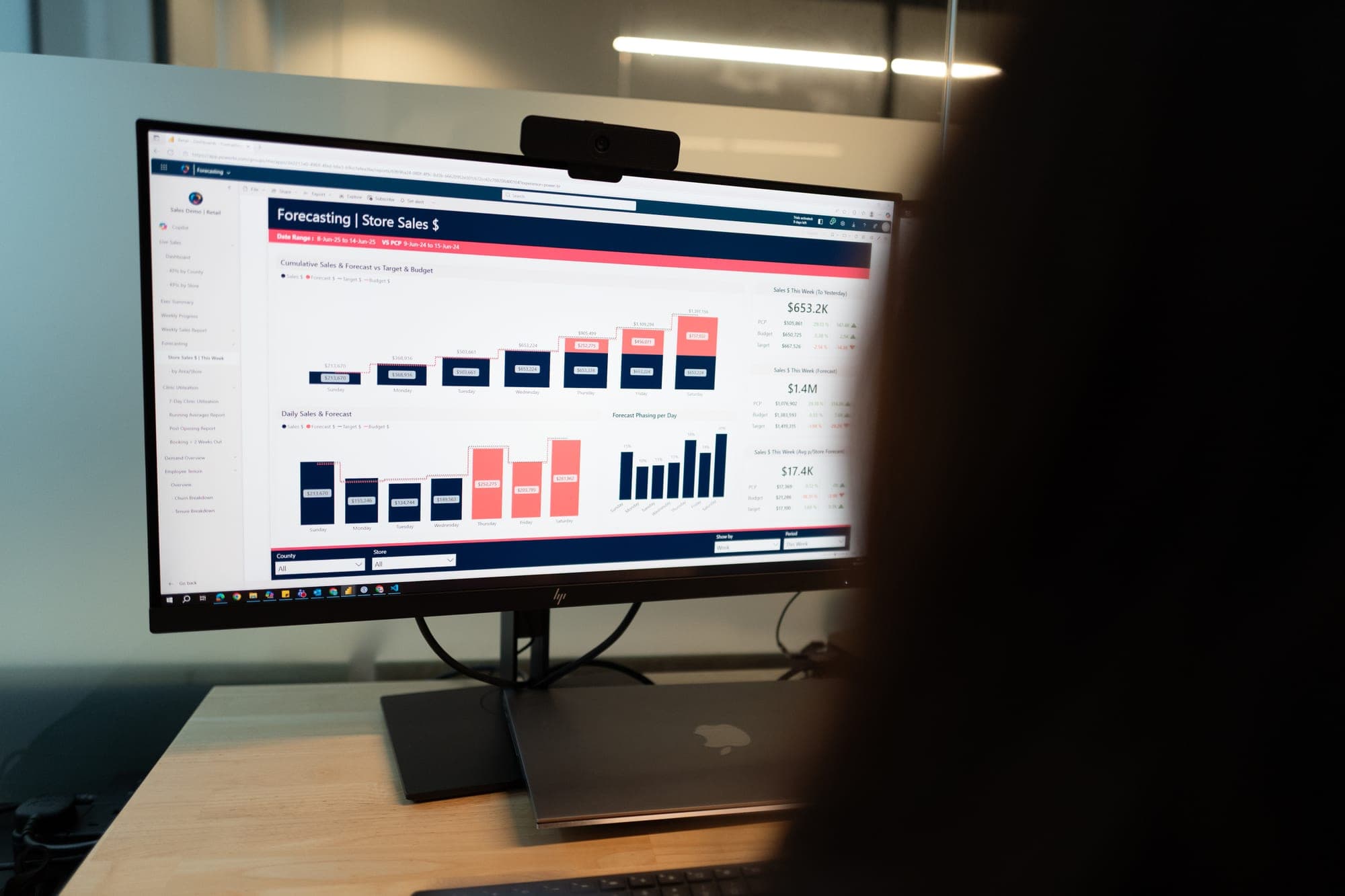

AI can now build a working first version of a Power BI model and dashboard in a few hours. That changes how we deliver Power BI, and what clients should expect from us. It doesn’t remove the need for experienced developers. It moves where their time goes.
Power BI development is a core part of what we do at InsyteGroup. Over the last year we have been using AI to accelerate our builds and, just as importantly, to support validation after the build. Here is what we have learned about where agentic development helps, and where the human touch still matters.
We think of a Power BI project as a 40/40/20 split: 40% understanding, 40% AI-assisted build and 20% expert craft. Understanding and the build together make up the first 80%. AI speeds that 80% up, but it doesn’t replace the understanding within it. The last 20% comes back to people.
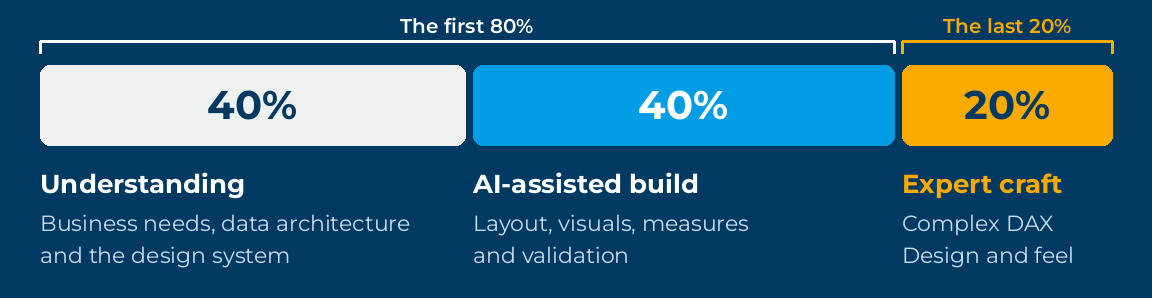
Put simply: we can outsource the assembly and checking to AI, but we can’t outsource the understanding and finesse. That still has to come from people who know the business and the data.
Understanding: the first 40%
This comes first, and it is led by people.
How the business operates
Before a single visual is placed, someone has to understand who will use the dashboard, what decisions it needs to support, and what those people do next with the answer. That upfront knowledge is what separates a dashboard that gets used from one that gets admired once and forgotten.
AI can build whatever you describe. Knowing what to describe comes from conversations with the business, and from experience of what works.
Getting the data architecture right
A good dashboard sits on good data. The transformation from silver to gold, where cleansed data is shaped into business-ready tables, needs to be exactly right. So does the shape of the semantic model.
Left to itself, AI will build a sensible, generic model. The difference we care about is a model built specifically for the business. A generic model works on day one and fights you on day ninety. A specific one reflects how the business actually thinks about its data, and makes every report built on top of it faster, simpler and more trustworthy.
A solid design system
AI only gets to a strong first version because there is a solid design system behind it: consistent layouts, visual styles and components that give it clear rules to build to. Without one, you get a generic first draft. With one, the first version arrives looking like it belongs to your business.
The AI-assisted build: the next 40%
This is the stage AI speeds up most.
Give AI (in our case Claude) a clear brief, a well-structured dataset and a solid design system and it will produce a dashboard roughly 80% of the way there, in a few hours rather than days. Layout, visuals, standard measures, first-pass formatting: the groundwork that used to consume a large share of a build.
We also lean on it heavily after the build. Validation is repetitive, detail-heavy work: checking numbers reconcile, testing measures against the source, and looking for inconsistencies. It is well suited to an AI that doesn’t get tired.
Expert craft: the final 20%
This comes last, and it is back with people.
Turning complex business logic into DAX
This is where AI struggles most. Complex DAX is rarely hard because of the syntax. It is hard because you need to know the data and the nuances of the business: why that figure is excluded, how that period is defined, what “active customer” really means here.
That context lives in the data and in the heads of the people who work with it. Getting calculations right takes an expert who has taken the time to understand both.
Fine-tuning design and interaction
The last 20% is where the craft is. Fine-tuning layout and hierarchy, getting interactions to feel natural, deciding what to leave out, and making the report intuitive for someone who has never seen it before.
This final mile is what turns a functioning report into one people want to open. It takes a developer with an eye for design and a feel for how users behave.
What this means for us
We are more efficient, and we have become more focused. The groundwork that used to create inertia at the start of a project now takes much less time, which frees our developers to spend their hours on the things above: understanding the business, shaping the architecture, solving the tricky business logic and the hard calculations, and refining the design.
It also changes the skills we invest in. With a lot of the assembly taken care of, what separates a good dashboard from a great one is the human part, so we have recently been putting more focus into design: layout, hierarchy, interaction and knowing what to leave out. The skills that matter most in our team are the ones AI can’t supply: understanding the business, an eye for how people use a report, and the judgement to get the logic right.
What this means for our clients
You see something early, and shape it together. We have always prototyped quickly. AI gets you there even sooner. People react to something real far better than to a specification, so feedback comes sooner and is sharper, and the result lands closer to what you need.
You can trust it sooner. AI-assisted validation means numbers are checked more extensively before they reach you, so you can trust what you see from day one.
Your budget goes further where it counts. Less effort on assembly means more on the parts that determine whether the dashboard is right: the design, the model and the calculations.
The bottom line
Agentic development doesn’t replace expert Power BI developers. It speeds up the build, so more of their time goes where it matters. We can outsource the assembly and checking to AI, but we can’t outsource the understanding and finesse: how the business works, what the data means and what decisions the dashboard has to support. That, and the final mile of craft, still belongs to experienced people.
If you are planning a Power BI project, or have a dashboard that never quite delivered, we would be glad to talk.